
Table of Contents
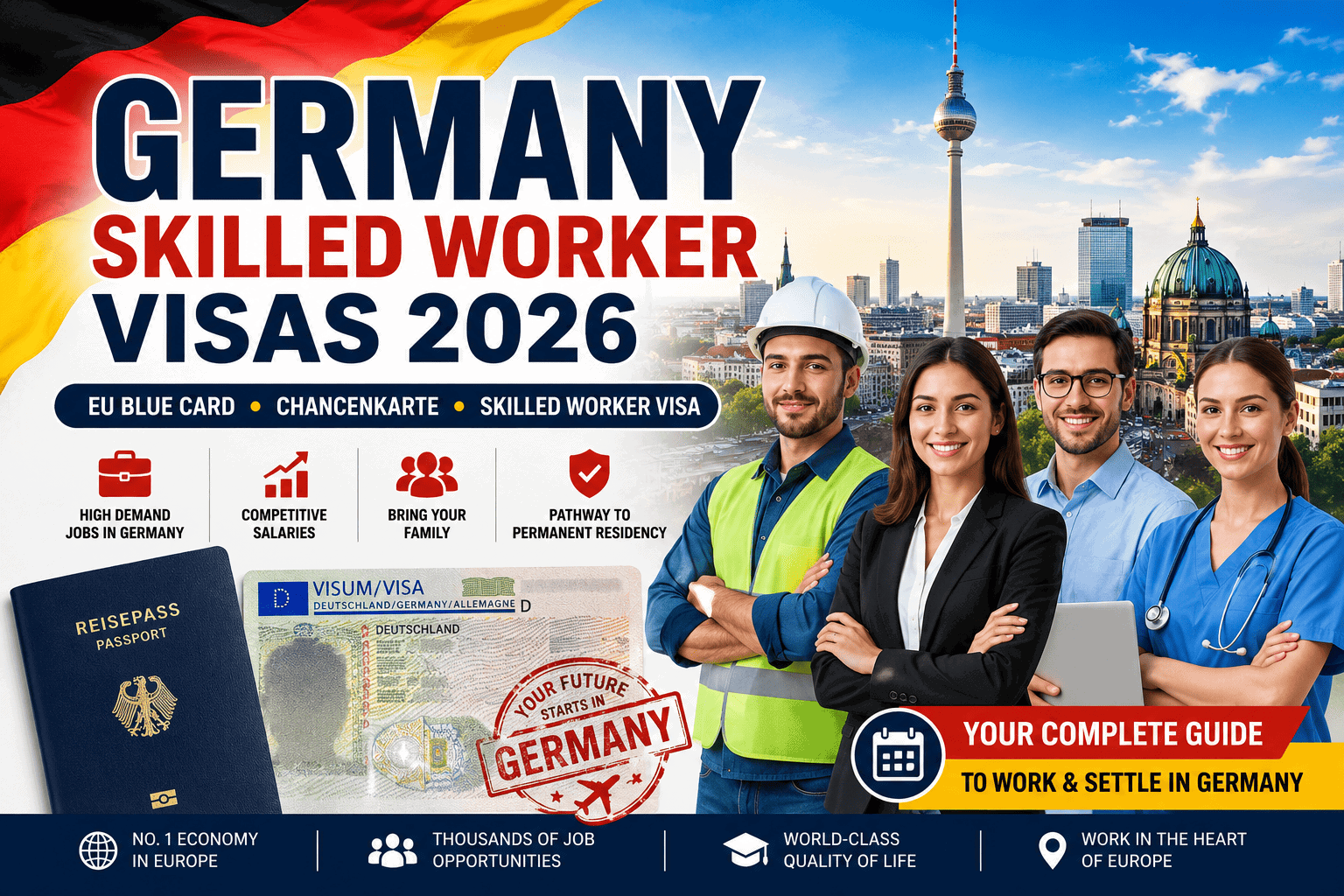
The Germany skilled worker visa 2026 landscape offers some of the best opportunities in Europe for international job seekers. Germany is facing a massive labor shortage, needing approximately 400,000 skilled workers every year to sustain its economy. For international job seekers from non-EU countries around the world, this represents a major opportunity. Whether you’re a healthcare professional, engineer, IT specialist, or skilled tradesperson, Germany offers multiple visa pathways designed to make relocation easier than ever. In this guide, we break down the three major routes, the EU Blue Card, the Chancenkarte (Opportunity Card), and the Blue-Collar Visa, so you can identify which one fits your profile and start planning your move to Germany.
Key Highlights
| Visa Type | Best For | Eligible Occupations | Job Offer Required | Salary Requirement | Language Requirement | Validity | Processing Time |
| EU Blue Card | Degree holders with a job offer | IT, Engineering, Healthcare, STEM, Management | Yes | €50,700+ annually (€45,934 for shortage occupations) | Not required for primary applicant | Up to 4 years, renewable | 4–10 weeks (if applying within Germany) |
| Chancenkarte (Opportunity Card) | Skilled workers without a job offer | Skilled workers across various professions | No | Proof of sufficient funds required | A1 German or B2 English | Up to 1 year | Varies by consulate |
| Blue-Collar Visa | Vocational/trades workers without a degree | Electricians, Plumbers, Welders, Drivers, Technicians, Care Workers | Yes | Based on employer contract | Basic German typically required | Tied to job contract | Varies by occupation |
Detailed Description
Germany’s Skilled Worker Immigration Program allows qualified non-EU nationals to legally enter and work in Germany under different pathways:
1. EU Blue Card
Designed for highly qualified professionals with recognized degrees and a German job offer meeting the minimum salary threshold. Popular occupations include:
- Software Developers
- Data Scientists
- Engineers
- Doctors
- Pharmacists
- Architects
- STEM Professionals
- Teachers
2. Chancenkarte (Opportunity Card)
Allows skilled workers to move to Germany without a job offer and search for employment for up to 12 months. Holders can:
- Work part-time up to 20 hours per week
- Attend job interviews
- Participate in trial employment
- Transition to a work permit after securing a job
3. Skilled Worker (Blue-Collar) Visa
Suitable for vocationally trained workers and skilled tradespeople such as:
- Electricians
- Welders
- HVAC Technicians
- Caregivers
- Truck Drivers
- Construction Workers
- Industrial Mechanics
- Plumbers
For more on Germany’s official immigration framework, see the Federal Foreign Office’s visa information page.
Benefits
- Access to Germany’s strong economy and high minimum wages
- EU Blue Card holders can reach permanent residency in as little as 21–27 months with basic German skills
- Spouses of Blue Card holders can work full-time immediately, with no employer sponsorship or sector restrictions, and no German language requirement
- Children get immediate access to public schools, Kita placement, and health insurance
- Chancenkarte holders can work part-time while job-hunting, easing financial pressure during the transition
- Smooth conversion path: Chancenkarte holders can switch to a Blue Card locally (within Germany) once they secure a qualifying job offer
- Strong legal protections for foreign workers under German labor law
Eligibility Criteria
EU Blue Card Requirements
- Recognized university degree or equivalent qualification
- Valid German job offer
- Employment contract for at least 6 months
- Minimum annual salary requirement:
- €50,700 (general threshold)
- €45,934 (shortage occupations)
- Health insurance coverage
Chancenkarte Requirements
- Recognized degree or vocational qualification
- Minimum 6 points under Germany’s points-based system (if applicable)
- German language level A1 or English level B2
- Proof of financial resources
- Valid passport
Skilled Worker Visa Requirements
- Recognized vocational qualification
- Job offer from a German employer
- Relevant work experience
- Language skills (depending on occupation)
- Health insurance
Required Documents
- Valid passport
- Educational certificates/degrees (with recognition status checked via Anabin, if applicable)
- Vocational training certificates (for Blue-Collar Visa applicants)
- Language certificates (A1 German or B2 English, depending on visa type)
- Proof of work experience
- Job offer letter or employment contract (where applicable)
- Health insurance proof
- Blocked account certificate showing proof of funds (mainly for Chancenkarte)
- Passport-sized photographs
- Completed visa application form
Application Process
- Determine your visa pathway based on whether you have a job offer, your qualification level (degree vs. vocational training), and your target sector.
- Verify qualification recognition through Germany’s Anabin database (anabin.kmk.org) to check whether your Pakistani degree or vocational certificate is recognized, partially recognized, or requires further assessment.
- Improve your language profile by enrolling in German language courses (Goethe-Institut Karachi, Lahore, or online platforms) to meet A1/B2 requirements depending on your chosen visa.
- Gather and authenticate documents, including getting your educational certificates attested by the HEC (Higher Education Commission) and the German Embassy/Consulate, as German authorities typically require this verification step for Pakistani applicants.
- Open a blocked account (for Chancenkarte applicants) through providers like Fintiba or Expatrio, which are commonly used by Pakistani applicants.
- Book your visa appointment through the German Embassy Islamabad or the Consulate General in Karachi, depending on your jurisdiction. Appointment availability can be limited, so booking 2–3 months in advance is recommended.
- Attend the visa interview, bringing all original documents plus photocopies, and pay the applicable visa fee (varies by visa category).
- Wait for processing, which can take anywhere from a few weeks to a few months depending on the visa type and current embassy workload.
- Travel and register, completing your Anmeldung (address registration) within two weeks of arrival in Germany, which is required for opening a bank account, getting health insurance, and other essential steps.
Deadline
These are ongoing immigration programs with no fixed application deadline. Applications are accepted year-round, and as of early 2026, there is no nationality quota in place for the Chancenkarte. However, processing times vary by consulate, so applying early is recommended.
How to Apply
To apply, visit the official website below:
Official German Immigration Portal:
Opportunity Card Application Portal:
EU Blue Card Information:
FAQs
1. Do I need a job offer to apply for a German work visa?
Not necessarily. The Chancenkarte allows you to enter Germany without a job offer to search for work, while the EU Blue Card and Blue-Collar Visa generally require one.
2. Is German language proficiency mandatory?
It depends on the visa. The EU Blue Card doesn’t require German for the primary applicant, but the Chancenkarte requires A1 German or B2 English, and the Blue-Collar Visa typically requires basic German.
3. Can I bring my family with me?
Yes, especially under the EU Blue Card, where spouses can work full-time immediately without sponsorship, and children get immediate access to schooling and healthcare.
4. How long does it take to get permanent residency?
EU Blue Card holders can qualify for permanent residency in as little as 21–27 months with basic German language skills, or longer without it.
5. Can I switch from a Chancenkarte to an EU Blue Card?
Yes. If you secure a job offer meeting the salary threshold while on a Chancenkarte, you can apply to convert locally at your Ausländerbehörde, typically within 4–10 weeks.
6. Is there a quota limiting how many people from Pakistan can apply?
No nationality-based quota has been announced as of early 2026 for the Chancenkarte.
Final Thoughts
Germany’s 2026 skilled worker visa landscape offers genuine, accessible pathways for Pakistani professionals and tradespeople across healthcare, engineering, IT, construction, and hospitality. Whether you already have a job offer and qualify for the EU Blue Card, or you want to search for work on the ground via the Chancenkarte, or you’re a skilled tradesperson eligible for the Blue-Collar Visa, there’s likely a route suited to your background. Start by checking your qualification recognition status and gathering your documents early, as Germany’s structural labor shortage means demand for skilled foreign workers isn’t slowing down anytime soon.
Disclaimer:
This article is intended for general informational purposes only and does not constitute legal or immigration advice. Visa requirements, salary thresholds, and processing procedures are subject to change. Readers are strongly advised to verify all details directly with the German Embassy/Consulate in Pakistan or the official Make it in Germany portal (make-it-in-germany.com) before making any application or relocation decisions.
