
Table of Contents
Choosing the best countries for STEM graduates to get PR in 2026 is one of the most important decisions you will make after completing your degree. Where you study directly determines how long you can stay, how quickly you can access permanent residency, and how much your STEM qualification is worth in the immigration system. For graduates in science, technology, engineering, and mathematics, the advantage is real: many countries fast-track STEM professionals through their immigration systems, award extra points for STEM occupations, and list STEM roles on priority skilled occupation lists. This guide breaks down the top 10 countries ranked by PR timeline, post-study work visa options, STEM-specific advantages, and overall ease of settlement for STEM graduates in 2026.
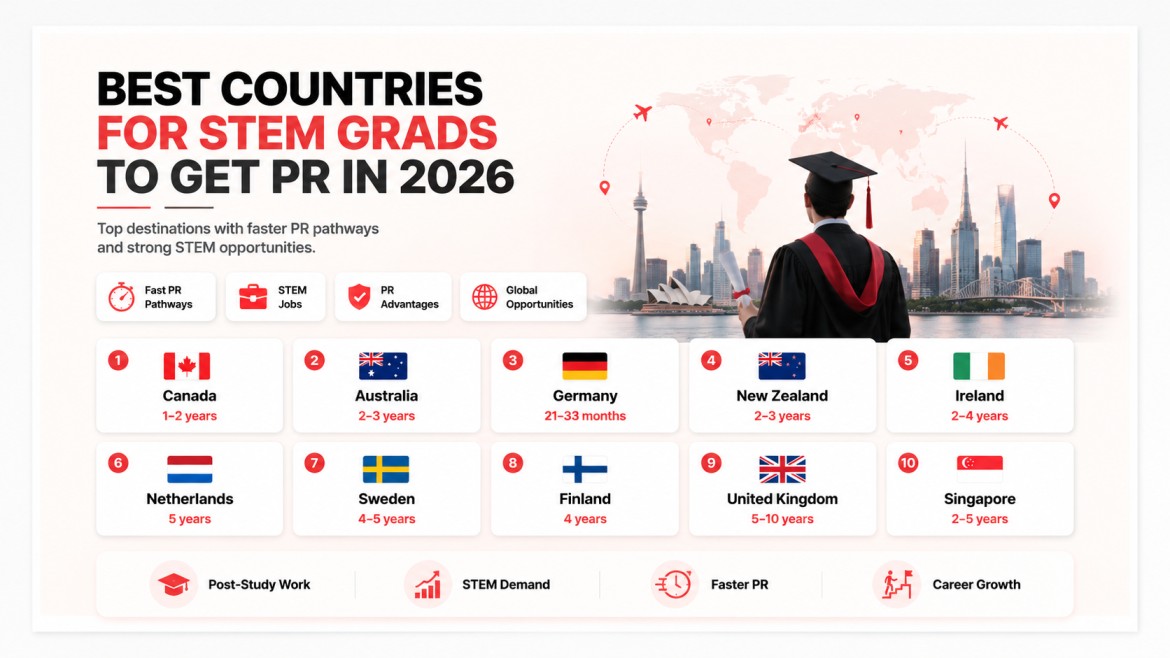
Best Countries for STEM Graduates to Get PR 2026: Quick Comparison
| Rank | Country | PR Timeline | High-Demand STEM Fields | STEM PR Advantage | Score |
| 1 | 🇨🇦 Canada | 1-2 years | AI, software, healthcare, engineering | STEM earns higher CRS points | 97/100 |
| 2 | 🇦🇺 Australia | 2-3 years | Engineering, cybersecurity, data science | Many STEM roles on Skilled Occupation List | 95/100 |
| 3 | 🇩🇪 Germany | 21-27 months | Mechanical, electrical, AI, manufacturing | EU Blue Card for skilled professionals | 93/100 |
| 4 | 🇳🇿 New Zealand | 2-3 years | Civil engineering, IT, healthcare | Strong demand for skilled graduates | 91/100 |
| 5 | 🇮🇪 Ireland | 2-4 years | Software, pharma, biotech | Critical Skills Occupations List | 89/100 |
| 6 | 🇳🇱 Netherlands | 5 years | Semiconductor, AI, engineering | Highly Skilled Migrant pathway | 87/100 |
| 7 | 🇸🇪 Sweden | 4-5 years | AI, green tech, software | STEM talent shortage | 85/100 |
| 8 | 🇫🇮 Finland | 4 years | ICT, AI, electronics | Fast-track residence for specialists | 84/100 |
| 9 | 🇬🇧 United Kingdom | 5-10 years | AI, data science, engineering | Skilled Worker shortage list | 82/100 |
| 10 | 🇸🇬 Singapore | 2-5 years | AI, fintech, semiconductor | Employment Pass to PR | 80/100 |
1. Canada: Best Country for STEM Graduates to Get PR in 2026 (Score: 97/100)
Canada is the #1 best country for STEM graduates to get PR in 2026, and by a significant margin. The Post-Graduation Work Permit (PGWP) allows graduates from eligible Canadian institutions to work for up to 3 years after completing a 2-year or longer program, with no restrictions on employer or field. During those 3 years, work experience feeds directly into Express Entry (Canada’s points-based permanent residency system) where STEM occupations earn higher Comprehensive Ranking System (CRS) points.
Canada plans to welcome approximately 380,000 new permanent residents in 2026, with strong demand in AI, software development, healthcare, and engineering. The Express Entry PR timeline for STEM graduates with Canadian work experience is typically 1-2 years from graduation, making it the fastest structured PR pathway of any country on this list. Provincial Nominee Programs (PNPs) add further options for STEM graduates in specific provinces.
| Feature | Details |
| Post-Study Work Visa | PGWP: up to 3 years (open work permit) |
| PR Pathway | Express Entry (CRS points system) + Provincial Nominee Programs |
| STEM Advantage | STEM occupations earn higher CRS points in category-based draws |
| PR Timeline | 1-2 years after graduation |
| High-Demand Fields | AI, software engineering, healthcare, data science |
| Score | 97/100 |
2. Australia: Fastest Points-Based PR for STEM (Score: 95/100)
Australia ranks #2 among the best countries for STEM graduates to get PR in 2026. The Temporary Graduate Visa (Subclass 485) gives STEM graduates 2 to 4 years of post-study work rights after graduation, with full work rights and no employer restrictions. After the 485 visa, graduates apply through General Skilled Migration, a points-based system where engineering, cybersecurity, IT, and data science roles score strongly.
Australia offers approximately 185,000 permanent residency places per year, with STEM occupations prominently featured on the Skilled Occupation List. A major advantage is that PR can be obtained without a job offer through the independent skilled stream, making it accessible even to graduates who have not yet secured sponsored employment. State and regional nomination add extra points and can significantly accelerate the PR timeline.
| Feature | Details |
| Post-Study Work Visa | Subclass 485: 2 to 4 years depending on qualification level |
| PR Pathway | General Skilled Migration (points-based), no job offer required |
| STEM Advantage | Many STEM roles on Skilled Occupation List, scores well in points system |
| PR Timeline | 2-3 years after graduation |
| High-Demand Fields | Engineering, cybersecurity, data science, IT, healthcare |
| Score | 95/100 |
3. Germany: Fastest PR in Europe for STEM Graduates (Score: 93/100)
Germany is the fastest PR pathway in Europe for STEM graduates and ranks #3 overall among the best countries for STEM graduates to get PR in 2026. After graduating from a recognized German university, graduates automatically receive an 18-month post-study job seeker visa: a residence permit that allows working up to 20 hours per week in any sector while searching for a full-time position in the field of study.
Once employed, STEM graduates earning €50,700 per year or above qualify for the EU Blue Card, one of the most powerful work permits in Europe. For shortage occupations (IT, engineering, mathematics, natural sciences), the threshold is lower at €45,934.20 per year. The EU Blue Card pathway leads to permanent residency in just 21 months (with B1 German language skills) or 27 months (with A1 German). Germany’s strong demand for mechanical engineers, electrical engineers, AI specialists, and manufacturing professionals makes it particularly attractive for STEM graduates.
| Feature | Details |
| Post-Study Work Visa | 18-month job seeker visa after graduation from German university |
| PR Pathway | EU Blue Card: €50,700/year general; €45,934.20/year for STEM shortage occupations |
| STEM Advantage | EU Blue Card fast-tracks STEM professionals to PR in 21 months |
| PR Timeline | 21 months (with B1 German) or 27 months (with A1 German) |
| High-Demand Fields | Mechanical engineering, electrical engineering, AI, manufacturing |
| Score | 93/100 |
4. New Zealand: Strong STEM Demand and Clear PR Pathway (Score: 91/100)
New Zealand ranks #4 among the best countries for STEM graduates to get PR in 2026. Post-study work visas run for up to 3 years, and the country has strong demand for civil engineers, IT professionals, and healthcare workers. The Skilled Migrant Category points system rewards STEM qualifications and New Zealand work experience. The country is smaller than Canada or Australia, but its immigration system is straightforward and its PR timeline is competitive at 2-3 years.
| Feature | Details |
| Post-Study Work Visa | Post-Study Work Visa: up to 3 years |
| PR Pathway | Skilled Migrant Category (points-based) |
| STEM Advantage | Strong demand for skilled STEM graduates across all sectors |
| PR Timeline | 2-3 years after graduation |
| High-Demand Fields | Civil engineering, IT, healthcare |
| Score | 91/100 |
5. Ireland: Critical Skills Fast Track for Tech and Pharma STEM (Score: 89/100)
Ireland ranks #5 among the best countries for STEM graduates to get PR in 2026. Home to European headquarters of Google, Meta, Apple, Microsoft, and dozens of leading pharmaceutical companies, Ireland has exceptional demand for software engineers, pharma specialists, and biotech researchers. The Critical Skills Employment Permit is specifically designed for high-demand occupations, many of which are STEM roles, and offers a direct pathway to long-term residency and PR within 2-4 years.
| Feature | Details |
| Post-Study Work Visa | Third Level Graduate Programme: up to 2 years |
| PR Pathway | Critical Skills Employment Permit to Long-Term Residency |
| STEM Advantage | Critical Skills Occupations List heavily weighted toward STEM |
| PR Timeline | 2-4 years after graduation |
| High-Demand Fields | Software engineering, pharma, biotech |
| Score | 89/100 |
6. Netherlands: Highly Skilled Migrant Pathway for Tech STEM (Score: 87/100)
The Netherlands ranks #6 among the best countries for STEM graduates to get PR in 2026. The country’s Highly Skilled Migrant (HSM) permit is one of Europe’s most accessible work permits for STEM professionals, with salary thresholds lower than the EU Blue Card in many cases. The Netherlands is a global hub for semiconductor technology, AI research, and engineering, home to ASML, Philips, Shell, and dozens of leading tech companies. The PR timeline is 5 years of legal residence.
| Feature | Details |
| Post-Study Work Visa | Orientation Year Permit: 1 year after graduation |
| PR Pathway | Highly Skilled Migrant permit to permanent residency |
| STEM Advantage | Highly Skilled Migrant pathway designed for tech and STEM professionals |
| PR Timeline | 5 years of legal residence |
| High-Demand Fields | Semiconductor, AI, engineering |
| Score | 87/100 |
7. Sweden: STEM Talent Shortage Makes PR Accessible (Score: 85/100)
Sweden ranks #7 among the best countries for STEM graduates to get PR in 2026. Sweden has a genuine STEM talent shortage, particularly in AI, green technology, and software development, which makes it relatively accessible for qualified STEM professionals. Sweden’s work permit system is employer-sponsored, but once in employment, the pathway to permanent residency is clear after 4-5 years. Sweden is also home to Ericsson, Spotify, and a thriving tech startup ecosystem.
| Feature | Details |
| Post-Study Work Visa | Job seeker permit available after graduation |
| PR Pathway | Work permit to permanent residency after 4-5 years |
| STEM Advantage | Active STEM talent shortage across multiple sectors |
| PR Timeline | 4-5 years |
| High-Demand Fields | AI, green tech, software development |
| Score | 85/100 |
8. Finland: Fast-Track Residence for ICT and AI Specialists (Score: 84/100)
Finland ranks #8 among the best countries for STEM graduates to get PR in 2026. Finland specifically fast-tracks ICT, AI, and electronics specialists through its residence permit system. The country is home to Nokia, Rovio, and a strong tech ecosystem with a growing demand for specialists in artificial intelligence, electronics, and information technology. Permanent residency is available after 4 years of continuous legal residence in Finland.
| Feature | Details |
| Post-Study Work Visa | Residence permit for job seeking after graduation |
| PR Pathway | Continuous residence permit to permanent residency |
| STEM Advantage | Fast-track residence specifically for ICT, AI, and electronics specialists |
| PR Timeline | 4 years of continuous legal residence |
| High-Demand Fields | ICT, AI, electronics |
| Score | 84/100 |
9. United Kingdom: Skilled Worker Shortage List for STEM (Score: 82/100)
The United Kingdom ranks #9 among the best countries for STEM graduates to get PR in 2026. The UK Graduate Route currently allows graduates from UK universities to work for 2 years (3 years for PhD graduates) without employer sponsorship. However, this route does NOT count toward Indefinite Leave to Remain (ILR) settlement required for PR. To get PR, graduates must transition to a Skilled Worker visa sponsored by an employer.
Important 2026 Update: The UK Graduate Route is confirmed to shorten to 18 months from January 2027 for new bachelor’s and master’s applicants (PhD graduates keep 3 years). Additionally, the standard ILR qualifying period is changing from 5 years to 10 years for most Skilled Worker visa holders from April 2026. High earners above £50,270/year for 3 consecutive years can still qualify in 5 years.
| Feature | Details |
| Post-Study Work Visa | Graduate Route: 2 years (3 years for PhD). Does NOT count toward ILR |
| PR Pathway | Skilled Worker visa (employer-sponsored) to ILR |
| STEM Advantage | Many STEM roles on Skilled Worker shortage occupation list |
| PR Timeline | 5-10 years (5 years for high earners above £50,270/year; 10 years standard from April 2026) |
| High-Demand Fields | AI, data science, engineering |
| Score | 82/100 |
10. Singapore: Employment Pass to PR for AI and Fintech STEM (Score: 80/100)
Singapore ranks #10 among the best countries for STEM graduates to get PR in 2026. Singapore is Asia’s premier tech hub, a global centre for AI research, fintech, and semiconductor manufacturing. The Employment Pass is the primary work permit for STEM professionals, and PR applications are processed on a case-by-case basis by the Immigration and Checkpoints Authority (ICA). While the PR process is less formulaic than Canada or Australia, STEM professionals in high-demand sectors have strong chances. PR timelines range from 2 to 5 years depending on individual circumstances.
| Feature | Details |
| Post-Study Work Visa | Employment Pass (employer-sponsored) after graduation |
| PR Pathway | Employment Pass to Permanent Residency (ICA discretionary) |
| STEM Advantage | Strong demand for AI, fintech, and semiconductor specialists |
| PR Timeline | 2-5 years depending on individual profile |
| High-Demand Fields | AI, fintech, semiconductor |
| Score | 80/100 |
Which Country is Best for Your STEM Field?
| STEM Field | Best Country | Why |
| AI and Machine Learning | Canada | Highest CRS points + AI ecosystem in Toronto, Montreal, Vancouver |
| Software Engineering | Canada or Ireland | Canada for PR speed; Ireland for Big Tech access (Google, Meta, Apple HQ) |
| Mechanical/Electrical Engineering | Germany | EU Blue Card + fastest European PR at 21 months |
| Cybersecurity | Australia | Cybersecurity on Skilled Occupation List + points-based PR |
| Data Science | Canada or UK | Canada for PR speed; UK for access to London finance sector |
| Semiconductor | Netherlands | ASML headquarters + Highly Skilled Migrant pathway |
| Biotech and Pharma | Ireland | Global pharma hub: Pfizer, Johnson and Johnson, AstraZeneca all based there |
| ICT and Electronics | Finland | Fast-track residence for ICT specialists + Nokia ecosystem |
| Fintech | Singapore | Asia’s fintech capital: MAS regulatory sandbox + strong demand |
| Green Technology | Sweden | Active green tech talent shortage + sustainability-focused economy |
Also Check
- 📌 Germany Skilled Worker Visa 2026 | EU Blue Card, Chancenkarte and Blue-Collar Visa Guide
- 📌 Countries Offering Job Seeker Visas 2026 | Work Abroad Without a Job Offer
- 📌 DAAD Scholarship 2027 in Germany | Fully Funded Master’s and PhD
- 📌 Chevening Scholarship 2027 | Fully Funded UK Government Master’s Scholarship
Frequently Asked Questions
1. Which is the best country for STEM graduates to get PR in 2026?
Canada is the best country for STEM graduates to get PR in 2026, scoring 97/100. The Post-Graduation Work Permit gives graduates up to 3 years of open work rights, STEM occupations earn higher Comprehensive Ranking System (CRS) points in Express Entry, and the PR timeline is just 1-2 years from graduation. Canada plans to welcome around 380,000 new permanent residents in 2026 with strong demand in AI, software, healthcare, and engineering.
2. Which country gives PR fastest for STEM graduates?
Germany gives PR fastest in Europe: in just 21 months via the EU Blue Card for STEM graduates earning €50,700 per year or above (€45,934.20 for shortage occupations). Globally, Canada offers the fastest overall PR pathway at 1-2 years through Express Entry for STEM professionals with Canadian work experience. Australia follows at 2-3 years through the General Skilled Migration points system.
3. Is the UK a good option for STEM graduates seeking PR in 2026?
The UK is a viable option but not the fastest. The Graduate Route gives 2 years of post-study work rights (3 for PhD graduates) but does NOT count toward ILR. STEM graduates must transition to a Skilled Worker visa for PR eligibility. The Graduate Route is confirmed to shorten to 18 months from January 2027, and the standard ILR qualifying period is changing to 10 years for most Skilled Worker holders from April 2026. Planning early is essential.
4. Which European country is best for STEM graduates to get PR?
Germany is the best European country for STEM graduates to get PR in 2026, scoring 93/100. The EU Blue Card pathway leads to PR in just 21 months for STEM professionals with B1 German language skills, or 27 months with A1 German. Ireland (89/100) is the best option for software, pharma, and biotech STEM graduates specifically, given its concentration of global tech and pharma company headquarters. The Netherlands (87/100) is the best choice for semiconductor and AI specialists.
5. Do STEM graduates have an advantage in Australia’s PR system?
Yes. Many STEM occupations including engineering, cybersecurity, data science, and IT appear on Australia’s Skilled Occupation List, which determines eligibility for General Skilled Migration PR applications. STEM graduates can apply for PR independently through the points-based skilled stream without needing employer sponsorship, and state or regional nomination can award extra points to fast-track the process. Australia offers approximately 185,000 PR places per year.
6. Can STEM graduates get PR in Singapore?
Yes, but the process is less formulaic than Canada or Australia. Singapore’s PR is granted on a discretionary basis by the Immigration and Checkpoints Authority (ICA). STEM professionals in high-demand fields, particularly AI, fintech, and semiconductor manufacturing, have strong profiles for PR consideration. Most successful PR applicants in Singapore have 2-5 years of Employment Pass work experience before applying. Singapore does not use a points-based system, so individual circumstances matter greatly.
7. Which country is best for AI and machine learning STEM graduates seeking PR?
Canada is the best country for AI and machine learning graduates seeking PR in 2026. Canada has three of the world’s leading AI research clusters in Toronto, Montreal, and Vancouver, with organizations like the Vector Institute, Mila, and the Alberta Machine Intelligence Institute. AI occupations score well in Express Entry’s CRS points system, and the PGWP gives AI graduates 3 years of open work rights to gain Canadian experience before applying for PR.
Final Thoughts
The best countries for STEM graduates to get PR in 2026 share three things: strong demand for STEM professionals, structured post-study work visa pathways, and clear routes from graduation to permanent residency. Canada leads with the fastest PR timeline and the strongest STEM immigration advantage. Germany leads in Europe with the fastest PR of any European country through the EU Blue Card. Australia offers the most transparent points-based system with no job offer required.
The right choice depends on your specific STEM field, language skills, and long-term goals. For AI and software engineers, Canada is the clear leader. For mechanical and electrical engineers, Germany offers the fastest European PR at 21 months. For semiconductor specialists, the Netherlands and Singapore are both strong options. Whatever country you choose, start building your post-graduation immigration plan before you graduate, not after. The graduates who secure PR fastest are almost always those who planned earliest.
