Table of Contents
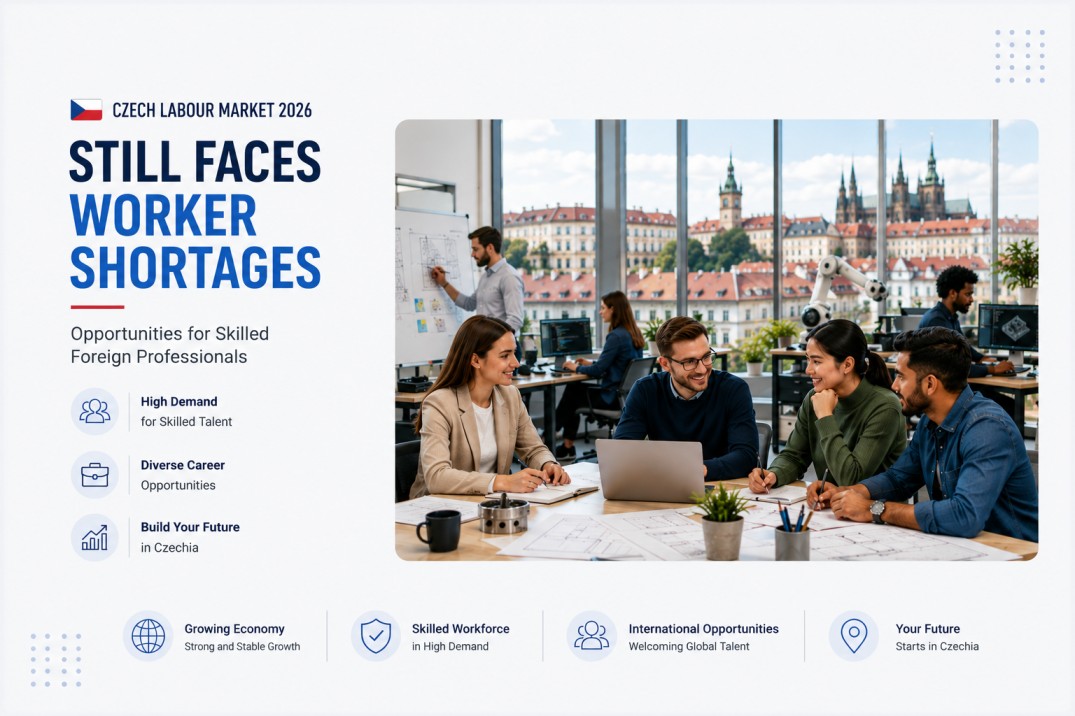
The Czech labour market 2026 continues to face one of the most persistent worker shortage crises in the European Union. Despite holding one of the EU’s lowest unemployment rates at approximately 4.5 percent, the Czech Republic has more than 200,000 unfilled positions across engineering, construction, healthcare, manufacturing, and IT. For international professionals seeking stable, well-paying job opportunities in Europe, the Czech labour market 2026 is one of the most actively recruiting destinations on the continent — and the government is actively changing its visa policies to welcome more foreign talent.
According to ManpowerGroup Czech Republic’s Q2 2026 Employment Outlook Survey, over six in ten Czech companies report difficulty filling positions, and 38 percent of employers plan to increase their staffing levels this year — the strongest first-quarter hiring outlook ever recorded in that survey’s history. Foreign workers now account for nearly 15 percent of the total Czech workforce, and government-backed programmes are expanding rapidly to attract professionals from Asia, Africa, and Latin America to fill critical gaps.
Czech Labour Market 2026: Key Facts at a Glance
| Indicator | 2026 Data |
| Unemployment Rate | ~4.5% (one of the EU’s lowest) |
| Registered Unemployed | 354,000+ |
| Unfilled Job Vacancies | 200,000+ positions |
| Employers Reporting Hiring Difficulty | 60%+ (ManpowerGroup Q2 2026) |
| Employers Planning to Increase Staffing | 38% |
| Foreign Workers in Czech Workforce | ~15% |
| Employee Cards Issued Annually | 70,000+ (projected 85,000+ in 2026) |
| Work Permit Processing Time | 60–90 days |
| Annual Domestic Labour Pool Decline | ~40,000 workers per year |
| Net Employment Outlook (Q1 2026) | +20 percentage points (record high) |
Why the Czech Labour Market 2026 Still Has a Worker Shortage
The structural reasons behind the Czech labour market 2026 worker shortage are well documented and long-running. The country’s domestic labour pool is shrinking at roughly 40,000 workers per year — far more people leave the workforce through retirement than enter through new graduates or returning emigrants. This demographic squeeze is compounded by a skills mismatch: the Czech educational system has not fully aligned with the rapid shift toward digital, technical, and service-sector roles that now dominate employer demand.
Emigration to higher-paying Western European countries has historically drained qualified Czech workers, particularly in healthcare, engineering, and skilled trades. The automotive sector — a cornerstone of Czech manufacturing — is simultaneously facing structural transformation driven by EV transition, forcing companies to seek entirely new skill profiles. According to Jaroslava Rezlerová, CEO of ManpowerGroup Czech Republic, “Sectors such as construction and especially the automotive industry are reporting growth in demand for employees, but in reality they are looking for very specific profiles.”
The Czech Chamber of Commerce found that 51 percent of Czech firms cited a lack of qualified workers as their single biggest barrier to business growth. ManpowerGroup’s Q2 2026 Employment Outlook Survey describes the Czech labour market 2026 shortage as a long-term structural challenge — not a short-term fluctuation driven by economic cycles.
Sectors with the Most Worker Shortages in the Czech Labour Market 2026
Worker shortages in the Czech labour market 2026 are concentrated in specific industries requiring specialized skills and professional experience. The following sectors have the most acute and sustained hiring needs:
- Information Technology (IT) and Tech Services: Software developers, cybersecurity specialists, network administrators, and data engineers are among the most sought-after professionals in Czechia. The tech and IT services sector has the highest share of white-collar foreign workers in the country, and companies are actively expanding headcount in 2026. Prague, Brno, and Ostrava are the primary tech hiring hubs.
- Engineering and Manufacturing: Mechanical, electrical, production, and automotive engineers remain critically short across the country. The manufacturing and engineering sectors depend heavily on experienced technicians, particularly in the automotive supply chain centred around plants in Central Bohemia and the Moravia-Silesia region.
- Construction and Infrastructure: Architects, civil engineers, plumbers, welders, and electricians are in sustained high demand due to ongoing nationwide housing and infrastructure development projects. Construction shortages are among the most severe in the Czech market.
- Healthcare and Social Services: Doctors, nurses, caregivers, physiotherapists, and pharmacists face persistent shortages driven by population ageing and increased healthcare demand. Teaching positions are also increasingly difficult to fill at all levels.
- Logistics and Transport: Truck drivers, warehouse operators, and logistics coordinators remain in short supply, particularly outside Prague, as the country’s e-commerce and freight networks continue to grow.
- Hospitality and Gastronomy: Hotels, restaurants, and the broader hospitality sector continue to struggle with vacancies for skilled cooks, service staff, and management roles — sectors heavily dependent on migrant labour.
- Green Economy and Renewable Energy: The Czech Republic’s transition away from coal dependency under EU-backed Just Transition funding is creating thousands of new roles in sustainable construction, environmental consulting, and renewable energy — a growth sector expected to peak in job creation by end of 2026.
Opportunities for Foreign Workers in the Czech Labour Market 2026
The Czech labour market 2026 has created a genuinely open environment for international professionals. The government has acknowledged that domestic hiring alone cannot close the gap, and has responded with concrete policy measures designed to attract skilled workers from outside the EU.
The Qualified Worker Programme and Highly Qualified Worker Programme are government-backed migration schemes that streamline the process for skilled non-EU nationals to obtain Czech work authorization. These programmes prioritize applicants from countries with existing bilateral agreements — including Ukraine, the Philippines, Mongolia, Vietnam, and India. Ukraine’s temporary protection measures have been extended through 2026, with facilitated work procedures for Ukrainian nationals already in the country.
A new regional allocation system is being introduced to direct foreign workers toward regions outside Prague facing the most acute shortages. South Moravia (Brno) leads the country in employer hiring optimism for 2026, recording the highest hiring expansion plans since tracking began in 2008. Bohemia ranks second. For EU citizens, freedom of movement means no work permit is needed. Non-EU nationals require either an Employee Card or an EU Blue Card for highly qualified professionals. The Czech Ministry of Interior is upgrading its digital processing system in 2026, with Employee Card issuance projected to rise from 70,000 to over 85,000 annually.
Salaries and Cost of Living in Czech Republic 2026
One of the reasons the Czech labour market 2026 attracts international workers is the combination of competitive wages and significantly lower living costs compared to Germany, Austria, or the Netherlands.
- Median Monthly Wage (Q2 2025): CZK 41,115 (~EUR 1,640 / USD 1,790), with real wage growth of 5.3% — among the fastest in the EU.
- 2026 Wage Forecast: Real wages projected to grow approximately 2.7% as inflation eases.
- Monthly Rent (single professional): CZK 15,000–28,000 in Prague; significantly lower in Brno, Ostrava, and regional cities.
- IT Professionals: Senior developers and cybersecurity specialists earn CZK 80,000–140,000 per month gross in Prague.
- Engineers: Experienced mechanical and electrical engineers earn CZK 55,000–95,000 monthly depending on seniority and sector.
- Healthcare Workers: Specialist doctors earn CZK 100,000–180,000 monthly; nurses CZK 40,000–65,000.
How to Apply for Jobs in Czech Republic 2026
Step 1: Identify Your Target Sector and Region
Match your professional background to one of the high-demand sectors above. Tech and IT roles are concentrated in Prague and Brno. Manufacturing and engineering roles are more accessible in Moravia-Silesia and Central Bohemia. Healthcare positions are available nationwide. Brno leads all regions in 2026 hiring optimism and is an excellent alternative base to Prague for foreign professionals.
Step 2: Search Official and Reputable Job Platforms
Use the EURES (European Employment Services) portal for verified cross-border job listings in Czechia. The Czech Ministry of Labour and Social Affairs (MPSV) official job board lists current domestic vacancies. Czech commercial platforms Jobs.cz, Profesia.cz, and LinkedIn Czech Republic publish thousands of active openings across all sectors daily.
Step 3: Apply and Secure a Job Offer
Most Czech employers require a CV in Czech or English, a cover letter, and relevant qualification certificates. For regulated professions — medicine, nursing, law — foreign qualification recognition (nostrification) through the Ministry of Education is mandatory before employment begins. IT and engineering roles generally do not require formal nostrification but expect demonstrable skills and portfolio evidence.
Step 4: Apply for Your Work Permit (Non-EU Citizens)
With a confirmed job offer from a registered Czech employer, apply for an Employee Card or EU Blue Card through the Czech Embassy in your home country. Required documents include a completed application form, valid passport, signed employment contract, proof of qualifications, accommodation evidence, health insurance, and a police clearance certificate. Standard processing takes 60–90 days. The 2026 digital portal upgrade is expected to accelerate processing for complete applications.
Step 5: Arrive and Register
On arrival, register with the Czech Foreign Police within 3 working days and enroll in the public health insurance system once employed. Czech language skills are not mandatory for most technical and IT roles but significantly improve daily life and long-term career prospects. Free Czech language courses are available through regional labour offices and integration centres nationwide.
Frequently Asked Questions
1. Why does the Czech labour market 2026 have shortages despite rising unemployment?
This is the defining paradox of the Czech labour market 2026. Unemployment has risen to 4.5 percent — a nine-year high — yet over 200,000 positions remain unfilled. The cause is a skills mismatch: people without jobs often lack the specific digital, technical, or healthcare qualifications that employers urgently need. Administrative and routine roles face rising unemployment simultaneously with acute shortages in specialized and skilled positions.
2. Which nationalities are most welcome to work in Czech Republic in 2026?
EU and EEA citizens need no work permit and can take up employment freely. For non-EU nationals, Czech government programmes currently prioritize workers from Ukraine (under extended temporary protection), the Philippines, Mongolia, Vietnam, and India under bilateral labour agreements. Czechia’s new 2026 economic strategy explicitly focuses on attracting more foreign skilled professionals to fill critical gaps across the economy.
3. How long does a Czech work permit take to process in 2026?
Standard Employee Card processing runs 60–90 days from application at a Czech embassy. The Czech Ministry of Interior is upgrading its digital infrastructure in 2026, with the enhanced portal expected to reduce processing times for complete and correct applications submitted through the new online system.
4. Do I need to speak Czech to work in Czechia?
For most IT, engineering, and international business roles — particularly in Prague and Brno — English is sufficient and Czech is not required. For healthcare, education, legal, and customer-facing roles, Czech language proficiency is typically essential. Free Czech language integration courses are widely available through local labour offices for registered foreign workers.
5. Is the Czech Republic a good long-term destination for foreign workers?
For many professionals, yes. The Czech labour market 2026 offers EU-standard employment protections, a well-developed public healthcare system, strong infrastructure, and among the fastest real wage growth in the EU. Living costs remain significantly lower than in Germany or Austria. The Employee Card provides a path to long-term residency, and after five years of legal residence, permanent residency becomes attainable.
6. Which Czech cities offer the best job opportunities for foreigners?
Prague remains the dominant employment hub, home to the majority of IT, financial services, and international company headquarters. Brno leads all regions in 2026 hiring optimism and offers a growing tech ecosystem with lower living costs than Prague. Ostrava in Moravia-Silesia is a key industrial and engineering centre undergoing significant green economy investment. Smaller regional cities are becoming increasingly competitive as the government’s regional allocation policy directs more workers and funding outside the capital.
7. Where can I find official Czech job vacancies as a foreign applicant?
The EURES portal (eures.europa.eu) lists verified cross-border Czech vacancies. The Czech Labour Office (Úřad práce ČR) at mpsv.cz publishes current domestic vacancies and official labour market data. ManpowerGroup Czech Republic, Grafton Recruitment, and Randstad Czech Republic are among the largest staffing agencies actively placing foreign workers across the Czech labour market 2026.
Final Thoughts
The Czech labour market 2026 remains one of the most active and opportunity-rich job markets in Central Europe for international professionals. With over 200,000 unfilled positions, record employer hiring optimism, government-backed foreign worker programmes, and real wages growing faster than almost anywhere else in the EU, Czechia is making a clear and sustained effort to welcome skilled talent from around the world.
The opportunity is open now. Identify your target sector, secure a verified job offer through EURES or the MPSV job board, and begin your Employee Card or EU Blue Card process at the nearest Czech embassy. With the right preparation, a stable and well-compensated career in the Czech labour market 2026 is within reach for qualified candidates from any country.