Table of Contents
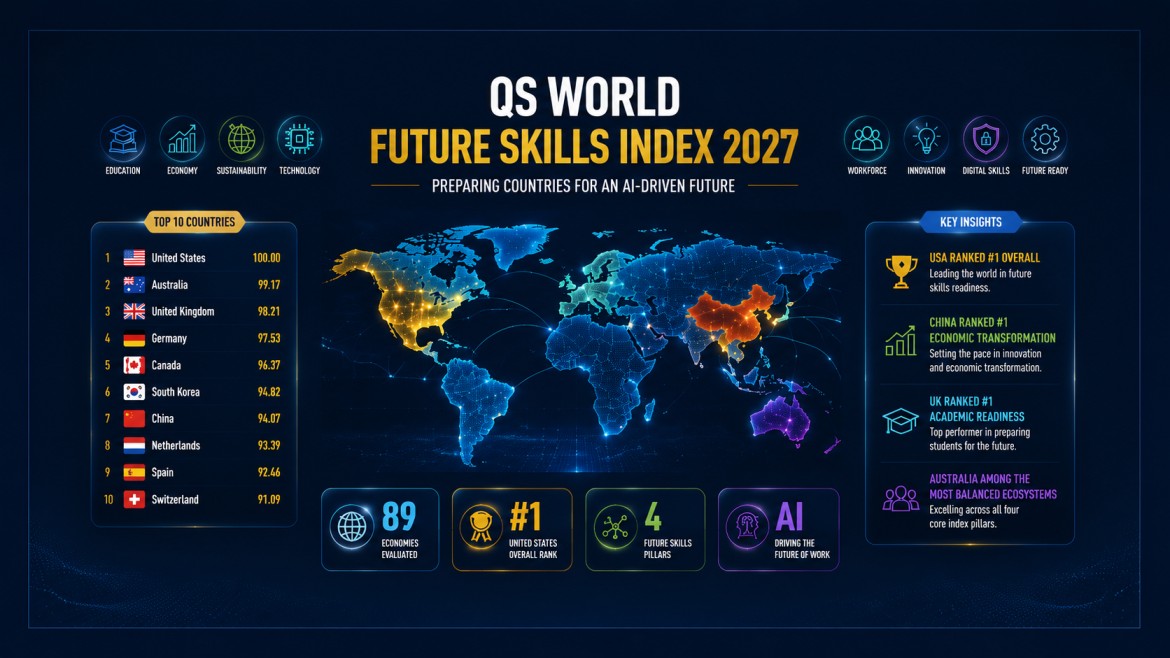
The QS World Future Skills Index 2027 has ranked 89 economies worldwide by their readiness to meet the demands of an AI-driven, digitally transformed, and sustainability-focused labour market. Released by QS Quacquarelli Symonds — the global higher education analytics organisation behind the QS World University Rankings — this index measures how well countries are preparing their graduates and workforces for the jobs, technologies, and skills that will define the global economy over the next decade. For students, researchers, and early-career professionals making decisions about where to study or build a career, the QS World Future Skills Index 2027 is one of the most practically useful global benchmarks available.
The index evaluates four equally weighted dimensions: Skills Alignment (how well education systems align with employer needs), Academic Readiness (the quality of universities in AI, digital, and green subjects), Economic Transformation (how effectively countries convert education investment into workforce outcomes), and the Future of Work indicator (how well job markets are preparing to recruit for digital, AI, and green skills). The United States leads the 2027 edition with an overall score of 99.2 out of 100 — but the rankings reveal genuinely surprising results and important nuances that matter for anyone planning their academic or career future.
QS World Future Skills Index 2027: Top 20 Countries
| Rank | Country | Overall Score |
| 1 | 🇺🇸 United States | 99.2 |
| 2 | 🇦🇺 Australia | 97.5 |
| 3 | 🇬🇧 United Kingdom | 96.5 |
| 4 | 🇩🇪 Germany | 95.5 |
| 5 | 🇨🇦 Canada | 93.7 |
| 6 | 🇰🇷 South Korea | 93.4 |
| 7 | 🇨🇳 China | 92.5 |
| 8 | 🇳🇱 Netherlands | 91.8 |
| 9 | 🇪🇸 Spain | 91.7 |
| 10 | 🇨🇭 Switzerland | 91.6 |
| 11 | 🇫🇷 France | 91.2 |
| 12 | 🇸🇬 Singapore | 91.0 |
| 13 | 🇮🇳 India | 89.0 |
| 14 | 🇸🇪 Sweden | 89.2 |
| 15 | 🇯🇵 Japan | 89.0 |
| 16 | 🇹🇼 Taiwan | 88.7 |
| 17 | 🇦🇪 United Arab Emirates | 86.5 |
| 18 | 🇭🇰 Hong Kong SAR | 85.1 |
| 19 | 🇩🇰 Denmark | 84.8 |
| 20 | 🇵🇱 Poland | 83.5 |
QS World Future Skills Index 2027: Ranks 21–40
| Rank | Country | Overall Score |
| 21 | 🇮🇪 Ireland | 82.3 |
| 22 | 🇮🇹 Italy | 81.0 |
| 23 | 🇮🇱 Israel | 80.4 |
| 24 | 🇹🇷 Türkiye | 79.2 |
| 25 | 🇦🇹 Austria | 79.0 |
| 26 | 🇫🇮 Finland | 78.8 |
| 27 | 🇧🇪 Belgium | 78.7 |
| 28 | 🇳🇿 New Zealand | 77.4 |
| 29 | 🇨🇿 Czechia | 76.7 |
| 30 | 🇳🇴 Norway | 75.0 |
| 31 | 🇦🇷 Argentina | 74.0 |
| 32 | 🇮🇩 Indonesia | 73.7 |
| 33 | 🇷🇺 Russian Federation | 72.5 |
| 34 | 🇸🇦 Saudi Arabia | 72.1 |
| 35 | 🇵🇹 Portugal | 71.4 |
| 36 | 🇲🇾 Malaysia | 70.3 |
| 37 | 🇨🇱 Chile | 68.9 |
| 38 | 🇵🇭 Philippines | 68.5 |
| 39 | 🇧🇷 Brazil | 68.1 |
| 40 | 🇱🇹 Lithuania | 67.2 |
How the QS World Future Skills Index 2027 Works
The QS World Future Skills Index 2027 is built on four equally weighted indicators, each contributing 25% of the final score:
- Skills Alignment: Measures how well a country’s education system aligns with actual employer needs and industry demand. It draws on data from the QS Global Employer Survey and over 280 million job postings to assess whether graduates leave university with the skills employers are hiring for — including AI proficiency, digital literacy, critical thinking, leadership, and green economy expertise.
- Academic Readiness: Evaluates the strength of a country’s universities in AI, digital, and sustainability-related academic disciplines, using QS World University Rankings by Subject data. Countries with high-quality programmes in these growth areas are best positioned to produce talent for the future economy.
- Economic Transformation: Assesses how effectively a country converts its education and talent investment into actual economic outcomes — including GDP growth, labour force participation, R&D expenditure, and higher education output. Data sources include the IMF, World Bank, and UNESCO.
- Future of Work: Measures how actively and successfully a country’s job market is recruiting for AI, digital, and green skills. Countries whose employers are already hiring for tomorrow’s skills gain a significant competitive advantage here.
Key Findings from the QS World Future Skills Index 2027
The QS World Future Skills Index 2027 goes well beyond simple country rankings. Here are the most important findings from the official report:
- The USA leads all four dimensions but shows a hidden vulnerability: The US scores 100 in both Skills Alignment and Future of Work, and 99.3 in Academic Readiness. However, the median rank position of American universities has fallen from 391 in 2017 to 760 in 2027 — a significant academic erosion that threatens long-term competitiveness even as the US dominates today.
- China leads Economic Transformation: The QS official data confirms China as the #1 ranked economy for Economic Transformation — the indicator measuring how effectively a country converts education and talent investment into actual economic productivity and growth.
- The UK’s conversion deficit: The UK achieves the highest Academic Readiness score in the entire index (100.0 — a perfect score) but converts this to an Economic Transformation score of only 90.2, a 9.8-point gap. Italy shows an even more severe pattern: Academic Readiness of 94.6 against Economic Transformation of just 78.4 — a 16.2-point gap indicating a severe disconnect between academic excellence and economic value creation.
- India ranks 13th and leads among lower-middle-income economies: India is ranked 5th globally on the Future of Work indicator with a score of 96.0, but 18th on Skills Alignment (82.7) — revealing a gap between the pace of labour-market transformation and the country’s ability to produce job-ready graduates. India’s National Education Policy 2020 is designed to address exactly this challenge.
- Small economies outperform their size: The Netherlands (8th), Switzerland (10th), and Singapore (12th) all rank in the global top 12 by concentrating investment in disciplines aligned with their specific economic strengths rather than competing across every field.
- Human skills are the most critical gap everywhere: US employers report gaps of −13.0 in Human Cognitive Skills and −12.2 in Human-Centered Leadership. Japan records the largest gaps in the entire index (−41.2/−36.6). Every top-seven ranked economy shows double-digit deficits in these human-centric skill clusters.
- Australia and Spain have the most balanced skills ecosystems: The Balance Index — measuring consistency across all four indicators — shows Australia, the US, and Spain as the most internally balanced top performers, meaning their talent systems are well-aligned with labour market demand across all dimensions simultaneously.
What the QS World Future Skills Index 2027 Means for Students
For students deciding where to study or build a career, the QS World Future Skills Index 2027 offers practical signals:
- High Skills Alignment = strong employer connections: Countries scoring highly here (US, Germany, South Korea) have education systems most tightly aligned with what employers are actively hiring for. Studying there means your degree is more directly relevant to available roles.
- High Academic Readiness = research and programme quality: The UK’s perfect score signals world-class academic programmes in AI, digital, and sustainability. Germany, Australia, and Canada also score exceptionally, reflecting globally recognised research institutions.
- High Economic Transformation = better career outcomes: Strong conversion scores correlate with lower graduate unemployment and higher starting salaries. The US, China, and Germany lead here — meaning graduates are most effectively absorbed into productive, well-paying roles.
- Emerging economies offer real domestic growth: India (13th), Indonesia (32nd), Saudi Arabia (34th), and Malaysia (36th) are all actively expanding their AI and digital capacity, creating genuine domestic career opportunities for graduates who choose to stay and build their careers at home.
Frequently Asked Questions (FAQs)
1. What is the QS World Future Skills Index 2027?
It is an annual global ranking published by QS Quacquarelli Symonds that measures how well 89 economies are preparing their graduates and workforces for the future of work in AI, digital, and green economy skills. It scores countries across four equally weighted indicators: Skills Alignment, Academic Readiness, Economic Transformation, and Future of Work readiness.
2. Which country ranked first in the QS World Future Skills Index 2027?
The United States ranked first with an overall score of 99.2 out of 100, achieving perfect scores of 100 in both Skills Alignment and Future of Work. Australia ranked second (97.5), followed by the United Kingdom (96.5), Germany (95.5), and Canada (93.7) to complete the top five.
3. Which country leads Economic Transformation in the QS Future Skills Index 2027?
China leads the Economic Transformation indicator — the dimension measuring how effectively a country converts education and talent investment into actual economic productivity and growth. This is a notable result given that China ranks 7th overall, showing that its strength in economic conversion is a standout feature of its performance even among the top global economies.
4. Why did India rank 13th despite being a developing economy?
India ranked 13th primarily because of its exceptional Future of Work score of 96.0 (5th globally), reflecting its large IT services workforce and growing role in AI, digital, and technology sectors. However, India ranks only 18th in Skills Alignment (82.7), revealing a gap between the pace of its labour-market transformation and its ability to produce job-ready graduates — a challenge the country’s National Education Policy 2020 is specifically designed to address.
5. What does the index say about human skills vs technical skills?
The index finds that human skills — critical thinking, complex problem-solving, leadership, and adaptability — are the most in-demand capabilities globally among employers, yet every top-ranked economy shows significant employer-reported gaps in these areas. Technical AI and digital skills matter, but the QS Global Employer Survey confirms that human cognitive capabilities are what graduates are most consistently falling short on, and these are also the hardest to automate.
6. How can students use the QS Future Skills Index to choose where to study?
Students can use the index to find countries with strong Skills Alignment scores (education systems aligned with employer needs), high Academic Readiness (strong university programmes in AI, digital, and green fields), and strong Economic Transformation scores (graduates successfully converted into productive employment). Countries in the top 15 generally offer the strongest combination of academic quality and career-market connectivity for future-oriented fields.
Final Thoughts
The QS World Future Skills Index 2027 is more than a league table. It is a comprehensive map of which economies are genuinely building the infrastructure — academic, economic, and institutional — to thrive in an AI-augmented, digitally driven future of work. For students, the rankings offer a practical lens for evaluating where to study, which disciplines to prioritize, and which career markets are most actively investing in tomorrow’s skills.
The full report, including detailed country profiles and indicator breakdowns for all 89 economies, is available at qs.com/insights/world-future-skills-index. Whether you are planning a Master’s degree, a career move, or simply trying to understand where the global economy is heading, the QS World Future Skills Index 2027 is essential reading.